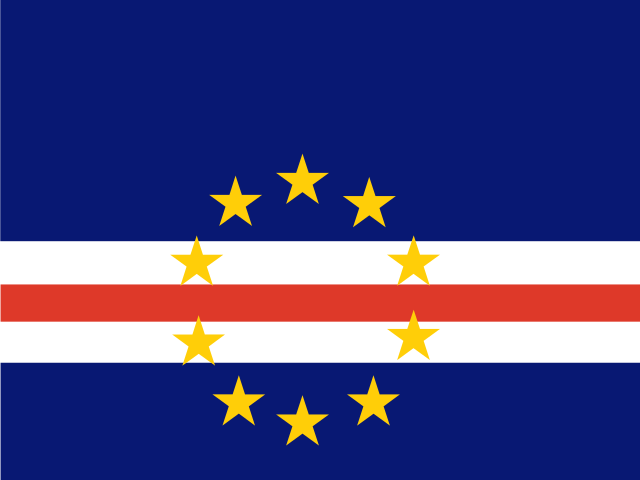
Cabo Verde
Cabo Verde has benefitted from preferential access to the EU market under the GSP+ since 2012, after having graduated out of the EBA and having ratified the 27 core international conventions on human and labour rights, environmental standards and good governance as required from GSP+ beneficiary countries. In 2024 and 2025, the World Bank classified the country as an upper-middle income one, with a per-capita income of $5,796 in 2025. EU imports from Cabo Verde amounted to €71 million in 2025 (similar as in the years before), and preferential imports under the GSP+ to €64 million (up from €52 million the year before). The EU is Cabo Verde's main trading partner.
What is the GSP+?
The GSP+ is a special incentive arrangement for Sustainable Development and Good Governance that supports vulnerable developing countries. Next to fulfilling the eligibility requirements of the Standard GSP, GSP+ countries are required to ratify 27 international conventions on human rights, labour rights, environmental protection and climate change, and good governance. In order to ensure effective implementation of the conventions as well as compliance with reporting obligations, the EU engages in monitoring activities with the GSP+ countries. GSP+ beneficiaries can benefit from complete duty suspensions for products across approximately 66% of all EU tariff lines.

At a glance: EU preferential imports from GSP+ beneficiary countries (2025, € million)
0.5M (2025)
Population
Parliamentary Republic
Government
6.3% (2025)
GDP Growth
2.3% (2025)
Inflation
$ 3.1B (2025)
GDP
Facts about Cabo Verde's economy
Island Economy
Cabo Verde is a small island economy with limited natural resources and arable land which explains the country's high dependence on the service sector.
Export Products
Cabo Verde's main export products are prepared or frozen fish (e.g. tuna, mackerel, skipjack, or squid) and other products made of fish, such as flours, meals, or pellets.
Trade Partners
Cabo Verde is highly dependent on the EU both as a destination for exports and as a source for imports. Trade with the EU accounted for 51% of total trade in 2025. Other international partners are the USA, China, and Brazil. Their individual trade shares, however, are below 10%.
Economic Structure
Cabo Verde's GDP is dependent on the service sector, particularly the tourism industry, which contributes about 68% to the GDP (2025). Industry (11%) and agriculture (5%) only contribute a smaller share. Remittances also play an important role for the West African country.
Usage of GSP+ Preferences
Cabo Verde used trade preferences granted under the GSP+ for 91% of its total exports in 2025. The preference utilisation rate, which represents the ratio of preferential imports to GSP+ eligible imports, was 95%.
Trade with the EU
EU total trade with Cabo Verde summed up to €483 million in 2025. 66% of the country's imports originated in the EU in 2025.
Cabo Verde and the EU
Imports from Cabo Verde by product section (2025, € million)
Imports from Cabo Verde over time (€ million)
CABO VERDE AND THE EU GSP
Economic Impact
95%
A large share of Cabo Verde's exports to the EU in 2025 were eligible for tariff reductions under the GSP+.
96%
Cabo Verde's preference utilisation rate in 2025.
96%
Share of zero-duty imports from Cabo Verde in 2025.
Preference utilisation and export diversification
EU imports from Cabo Verde (€ million)
Preference utilisation (%) vs. total eligible imports (in € million)
Most of the EU's imports from Cabo Verde are eligible for GSP+ preferences. Eligible imports were volatile over the years. Cabo Verde's preference utilisation rate was around 90% in most recent years but somewhat dropped to just above 80% in 2023 and 2024, before recovering to 95% in 2025.
The largest product sections under the GSP+ (€ million, 2025)
Products of the fishery sector - fish and especially fish preparations - are by far the most important EU imports from Cabo Verde. Whereas imports of fish preparations have increased from 2022 to 2025, imports of fish have decreased strongly and been overtaken by apparel, footwear, and furniture & toys. Preference utilisation of these product groups is almost 100%. Overall, further diversification remains a challenge given the geographic and structural restrictions of Cabo Verde.
SUSTAINABLE DEVELOPMENT AND MONITORING PRIORITIES
Following a sharp decrease in GDP during the COVID-19 crisis, Cabo Verde has shown a remarkable economic turnaround in recent years, with a GDP growth of over 7% in 2024. During the pandemic, Cabo Verde designed and timely implemented efficient measures to preserve the country’s economic and social fabric, which were adopted in close cooperation with international partners. Reflecting Cabo Verde’s economic progress, the World Bank first classified it as an Upper-Middle-Income Country in July 2025.
Over the period 2023 to 2025, the following positive developments were noted:
- Human rights: Adopted progressive legal frameworks and improvements in access to justice, press freedom and gender equality. Important efforts have been made in combating violence against women and children abuses and improving prison overcrowding.
- Labour rights: Made progress combating certain types of child labour, as well as in promoting equal pay, addressing discrimination at work and against migrant workers.
- Environment/Climate: Advanced climate objectives.
- Governance: Strengthened investigative, judicial, and financial response capability to drug trafficking.
Remaining issues and priorities for future engagement are:
- Human rights: Further progress on substance is needed in the adoption of comprehensive anti-discrimination legislation and strengthening prevention, protection and access to justice for victims of gender-based violence and child abuse. Addressing prison overcrowding and staffing shortages also remains urgent and there is a need to strengthen data collection and public reporting on human rights violations.
- Labour rights: More progress is needed on fostering social dialogue, establishing effective trade unions, enforcing equal pay and child labour protections. The number and capacity of labour inspectors should also be strengthened, data collection improved and social protection programmes to address poverty enhanced.
- Environment/Climate: Implementation remains uneven, with key legal frameworks still requiring updating or completion, and institutional capacity remaining limited. More attention is needed to effective and timely implementation of relevant conventions, including through improvement of reporting and monitoring systems.
- Governance: Drug trafficking and rising domestic consumption remain a challenge. There is a need to bolster anti-drug trafficking efforts through regional cooperation and intelligence-sharing, while stepping up drug prevention; strengthening operational capacity of the Corruption Prevention Council and finalising accession to the African Union Convention on Preventing and Combating Corruption (AUCPCC) to reinforce anti-corruption mechanisms.
For more information about Cabo Verde's compliance with the GSP conventions, see the convention compliance database. Also see the factsheet on Cabo Verde.
Monitoring priorities during the reporting period 2024-2025
Anti-discrimination legislation
Protection against child labour and exploitation
Collective bargaining
Labour non-discrimination
Equal remuneration
Combating drug trafficking
Implementation of environmental conventions
Combating corruption and money laundering
For the reporting period 2024-2025, the EU has focussed its monitoring activities on eight priority areas. Despite the difficult context, Cabo Verde maintained the effective implementation of international conventions and good rates in human rights and corruption perception indexes. Elections (local, parliamentary, and presidential) between October 2020 and October 2021 fully complied with international standards, including on transparency and peaceful acceptance of results.